Canal Saint-Martin: The Paris Neighborhood Guide That Skips Every Tourist Cliché
We’ll say it directly: if you’re visiting Paris and spending all your time between the Eiffel Tower and the Marais, you’re seeing a version of the city that Parisians barely recognize as their own. It’s beautiful, sure. But it’s not where anyone lives.
Canal Saint-Martin is where they live. Stretching through the 10th arrondissement — from Place de la République up toward Stalingrad — this neighborhood built around a 19th-century waterway is everything the tourist center isn’t. Unpolished. Animated. Full of people who chose to be here rather than passing through on a bus tour.
We walked it for days, sat in its cafés through entire afternoons, and asked everyone from baristas to bartenders what’s worth knowing in 2026. This is what we found.
Why Canal Saint-Martin Feels Like the Real Paris
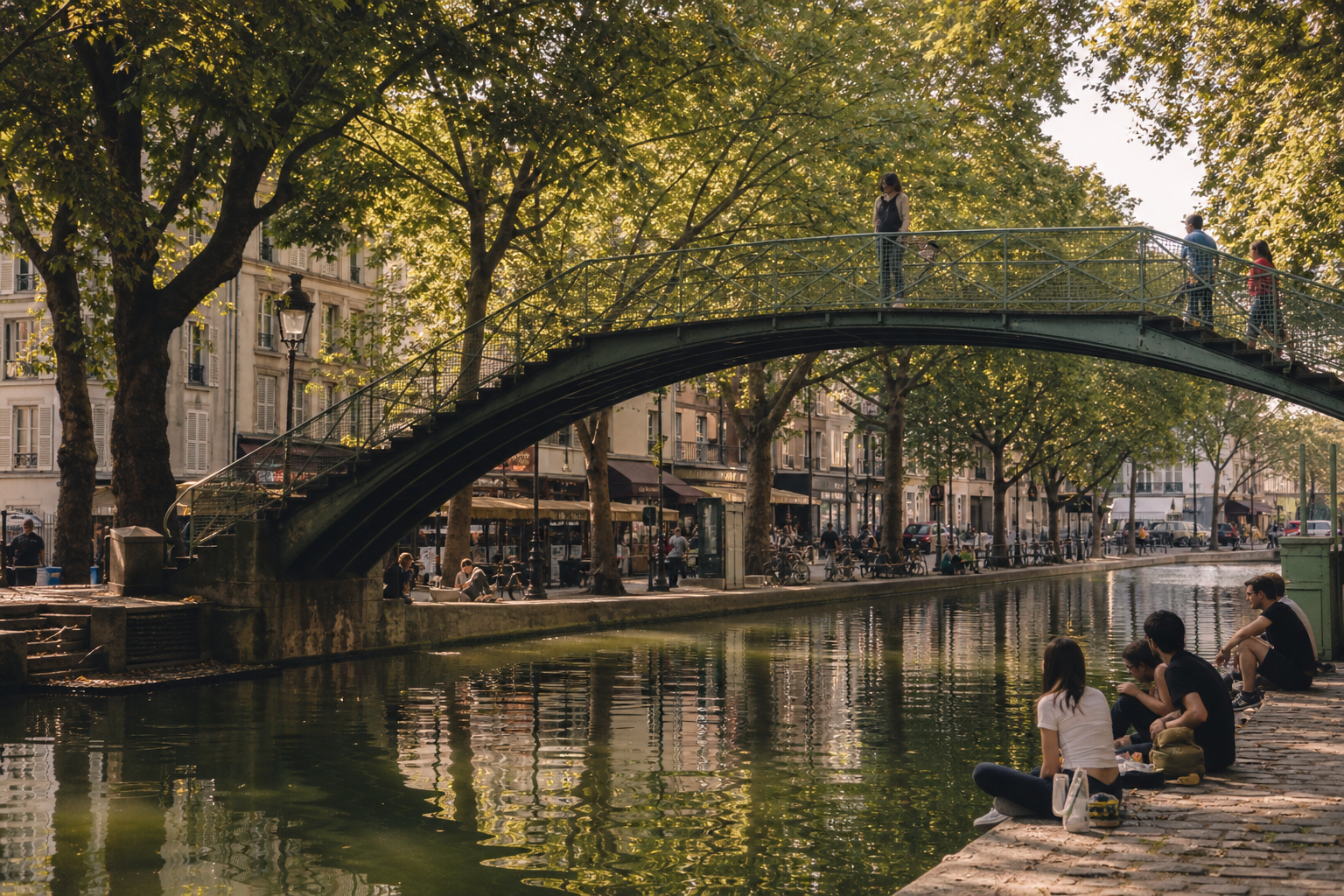
The canal itself is the backbone — 4.5 kilometers of tree-lined waterway with iron footbridges, locks that still operate, and banks where half the neighborhood sits on warm evenings with a bottle of wine and a baguette. You’ve probably seen it in films (Amélie had that stone-skipping scene here) but on the ground, it’s less cinematic and more just… pleasant. Like a living room the whole neighborhood shares.
What makes Canal Saint-Martin feel genuinely Parisian — as opposed to the museum-quality preservation of the Marais or Saint-Germain — is that it’s still slightly messy. The buildings are Haussmann-era handsome but not all renovated. The businesses are independent, not chains. The crowd is a mix of young families, creative-industry workers, students from the nearby university hospitals, and older residents who’ve been here for decades.
The 10th arrondissement as a whole is one of Paris’s most diverse, and that diversity shows up in the food, the shops, and the street life. You’ll hear more languages on Rue du Faubourg Saint-Denis (which feeds into the canal area) than anywhere in the tourist center.
There’s no single monument here. No “must-see.” And that’s precisely why it feels like Paris — because real cities aren’t organized around highlights for visitors. They’re organized around the daily rhythms of coffee, work, lunch, aperitivo, dinner. Canal Saint-Martin is built for all of those.
Best Cafés and Coffee Along the Canal
Paris’s specialty coffee scene has exploded over the past decade, and Canal Saint-Martin was an early epicenter. The neighborhood has cafés for every mood — third-wave pour-over spots for the serious coffee drinker, classic zinc-counter cafés for those who want espresso standing up, and everything in between.
For specialty coffee: The area around Rue Beaurepaire and Rue de Marseille hosts several roaster-cafés pulling excellent shots. Look for places with single-origin menus and latte art competitions on their Instagram. The scene here changes faster than we can print, but the concentration of quality is consistent — you won’t have to walk far to find a good flat white.
For the classic café experience: The canal-side terraces are the draw. Grab any seat facing the water on a sunny morning. You’re paying for the setting as much as the coffee, and that’s fine. Café culture here isn’t about the bean — it’s about the two hours you spend watching boats navigate the locks while you read.
For working: Several cafés along the canal welcome laptops in the morning (less so during lunch rush). The neighborhood draws freelancers, and the infrastructure reflects it — good Wi-Fi, power outlets, and no one rushing you out.
Our routine: Morning coffee at a specialty spot on a side street (cheaper, better quality), then migrate to a canal-side terrace around 11:00 once the sun hits the water. The combination is hard to beat.
Where to Eat: From Brasseries to Street Food
Canal Saint-Martin’s food scene is defined by two things: diversity and a refusal to be pretentious. This isn’t the kind of Paris neighborhood where you need a jacket or a reservation three weeks out. It’s the kind where you wander and choose based on what smells right.
Brasseries and bistros:
The classic French brasserie is alive and well here. Maison Saint Martin represents the neighborhood’s brasserie revival — a proper zinc bar, tiled floors, and a menu that does updated French standards without the ironic quotation marks that trendier neighborhoods add. Think duck confit that actually tastes like your great-aunt made it, but with a wine list that reflects 2026 rather than 1996.
Along the canal itself and the streets feeding into it, you’ll find bistros at every price point. The neighborhood standard for a two-course lunch (entrée + plat, or plat + dessert) runs around €16-20 — significantly less than equivalent quality in the 6th or 7th arrondissements.
Street food and casual:
This is where the 10th arrondissement’s diversity shines. The Rue du Faubourg Saint-Denis corridor (a 5-minute walk from the canal) is one of Paris’s great eating streets — Turkish grills, Indian canteens, Chinese noodle shops, and African restaurants all competing for your attention.
Shwi, a 2026 opening, has brought Lebanese street food to the canal area proper — the kind of precise, ingredient-focused casual food that Paris does brilliantly when it stops trying to be fine dining.
For a splurge: The neighborhood has a handful of contemporary French restaurants doing tasting menus and natural wine pairings at prices that would double in Saint-Germain. Ask locally what’s exciting right now — the scene moves fast.
Our tip: Eat lunch on the canal, dinner on the side streets. Lunchtime canal-side is magical (the light on the water, the footbridge views). Evening is when the side-street restaurants shine, when the neighborhood fills with residents rather than passersby.
Bars and Nightlife (Including 2026 Openings)
Canal Saint-Martin after dark is one of Paris’s best-kept open secrets. While tourists pack into overpriced cocktail bars in the Marais, locals are drinking better and paying less along these canal-side streets.
Natural wine bars: The 10th arrondissement is ground zero for Paris’s natural wine movement. Small, often standing-room-only bars where the owner is also the sommelier, pouring biodynamic wines from small French producers you’ve never heard of. Expect chalkboard menus, glasses starting around €6-7, and a crowd that’s passionate about what’s in their glass. If you enjoyed our piece on tiny wine bars in Oberkampf, you’ll find the same energy here — just with more space.
Cocktail bars: The canal area has caught up to the Marais and Oberkampf in cocktail culture. Minuit Express, a 2026 opening, has brought an inventive cocktail program to the neighborhood — the kind of place that takes its drinks seriously without taking itself seriously. No passwords, no hidden entrances, just good drinks in a relaxed space.
Paris’s bar scene overall has been expanding into neighborhoods like this — places where rent allows creativity. The result is cocktail menus that reflect genuine thought rather than tourist-volume pricing.
Canal-side drinking: On warm evenings (April through October), the banks of the canal become an open-air bar. Parisians pick up bottles from local cavistes (wine shops), grab some cheese and bread, and sit on the canal edge. It’s legal, social, and completely free. This is arguably the most Parisian drinking experience available — no establishment required, just good wine and the sound of water through the locks.
Late night: The area around Rue de la Grange aux Belles and toward Place de la République keeps going later than the canal-side spots. If you’re looking for something past midnight, drift south toward République where the 10th meets the 3rd and 11th arrondissements.
Shopping: Bookshops, Vintage, and Independent Boutiques
Canal Saint-Martin shopping is everything the Champs-élysées isn’t. Independent, curated, occasionally eccentric. The neighborhood has a strong identity in what it sells — and chain stores haven’t yet colonized the way they have in other central Paris areas.
Bookshops: Several excellent independent bookshops line the streets near the canal, including those specializing in art books, graphic novels, and photography. Browse without agenda — the joy here is in what you discover, not what you came for.
Vintage and secondhand: The 10th arrondissement has some of Paris’s best vintage shopping. Clothing from the ’70s through ’00s, curated rather than thrift-store chaotic, at prices that reflect the neighborhood’s mix of creative-class residents who care about curation but not luxury-brand markup.
Independent boutiques: French and international designers with small production runs, homeware shops stocking ceramics from French artisans, stationery stores that take paper seriously. The throughline is craft and independence — you won’t find anything here that you could find in a department store.
Record shops: Vinyl neighborhood’s creative identity extends to its vinyl stores. Expect well-curated selections of jazz, electronic, and world music, often with owners who’ll spend 20 minutes talking you through their recommendations.
Market days: Check for local marché schedules. The covered market on the nearby Rue du Chéteau d’Eau and the open-air markets provide the full Parisian market experience — cheeses, flowers, produce — without the Rue Mouffetard tourist crowds.
Practical Tips: Getting There and Where to Stay
Getting there:
Canal Saint-Martin is absurdly well-connected. The neighborhood is served by multiple metro stations:
- République (Lines 3, 5, 8, 9, 11) — southern end of the canal
- Jacques Bonsergent (Line 5) — central canal
- Goncourt (Line 11) — eastern edge
- Gare de l’Est (Lines 4, 5, 7) — northern end
- Jaurés (Lines 2, 5, 7bis) — where the canal opens up at Bassin de la Villette
From most tourist areas, you’re one metro ride away. From the Marais, it’s walkable in 15 minutes. From Montmartre, take Line 5 from Anvers area. From Saint-Germain, Line 4 to Gare de l’Est puts you at the canal’s northern stretch in 20 minutes.
Where to stay:
If you’re choosing a hotel or apartment base, the canal area is one of our top recommendations. You’re central without paying centre-of-Paris prices, well-connected to everywhere via metro, and you wake up in a real neighborhood rather than a tourist zone. Hotels here tend toward boutique and design-forward rather than palatial — which suits the neighborhood.
Look for accommodation along Rue des Récollets, Quai de Valmy, or Quai de Jemblapes for canal-facing rooms. Side streets like Rue Beaurepaire and Rue de Marseille offer quieter options that are still a 2-minute walk from the water.
Extending your day:
Canal Saint-Martin connects naturally to several other neighborhoods worth exploring:
- Walk south to République and into the upper Marais (10 minutes)
- Walk northeast along the canal to Bassin de la Villette for a completely different vibe — wider water, more space, a cinema on the water in summer (20 minutes)
- Cross east into Belleville for Paris’s best multicultural food scene and panoramic city views from Parc de Belleville (15 minutes)
The canal itself is a walking route. Following it from République all the way up to Parc de la Villette takes about 45 minutes and passes through three distinct atmospheres — intimate canal locks, opening waterway, and finally the wide basin with its cultural venues.
Canal Saint-Martin is best explored on foot, and it connects beautifully to a wider Paris walking day. Our free Paris walking tours cover complementary parts of the city — combine them with a canal afternoon for a full picture of Paris that most visitors never see.
Planning where to base yourself? We recommend the 10th arrondissement for its balance of access, authenticity, and value — check current hotel availability near Canal Saint-Martin for your dates.